Biocracked
←

#endothelial function

2 articles
Approach: human outcome. Palette: natural.

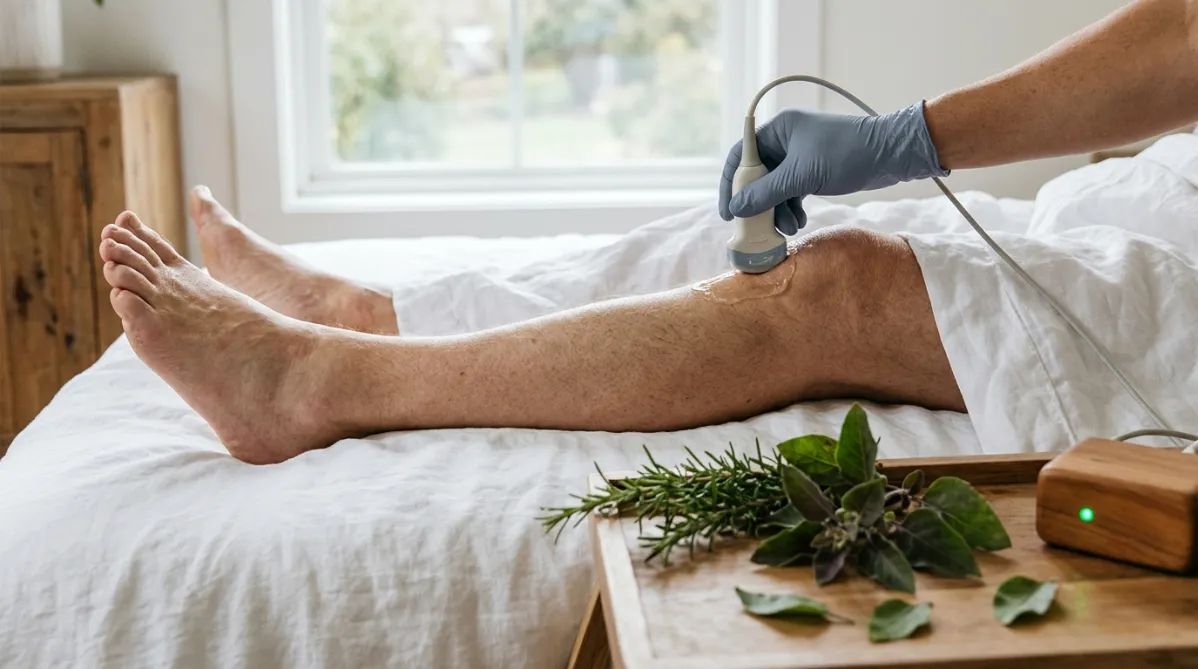
Close, low-angle shot of an older adult's bare lower leg and bare feet resting on crisp white hospital bed linen, with a soft, out-of-focus window in the background. The camera sits at mattress level and looks along the calf toward the ankle. Face is not visible. A small ultrasound probe coated in clear gel presses against the back of the knee. The operator's gloved hand enters from the frame edge. Soft overcast daylight from the window gives skin tones a warm, realistic look. Around the bed, a sprig of fresh rosemary and a few purple-green ashwagandha leaves sit on a wooden bedside tray. The leaves provide plant-green accents, along with one small electric green sensor light on a monitor. Palette: natural greens, wood browns and warm skin. Mood: quiet, careful and hopeful.
supplements

PB125: The Herbal Nrf2 Blend That Kept Arteries Working in Bed Rest

BY NOVA CHEN ·

A botanical Nrf2 activator called PB125, made from rosemary, ashwagandha and luteolin, has now been tested in a small, double-blind human trial. In 24 older adults, two weeks at 200 mg/day raised brachial FMD from 2.8% to 3.8% and popliteal FMD from 1.5% to 2.3%. During five days of bed rest, the blend preserved artery function and antioxidant levels compared with placebo. Younger adults saw no baseline FMD gain, though PB125 protected popliteal FMD during limb immobilization. With only 44 participants and surrogate endpoints, it's a promising signal rather than proof of clinical benefit.
**Approach:** Conceptual metaphor, in a bold color field palette (D).

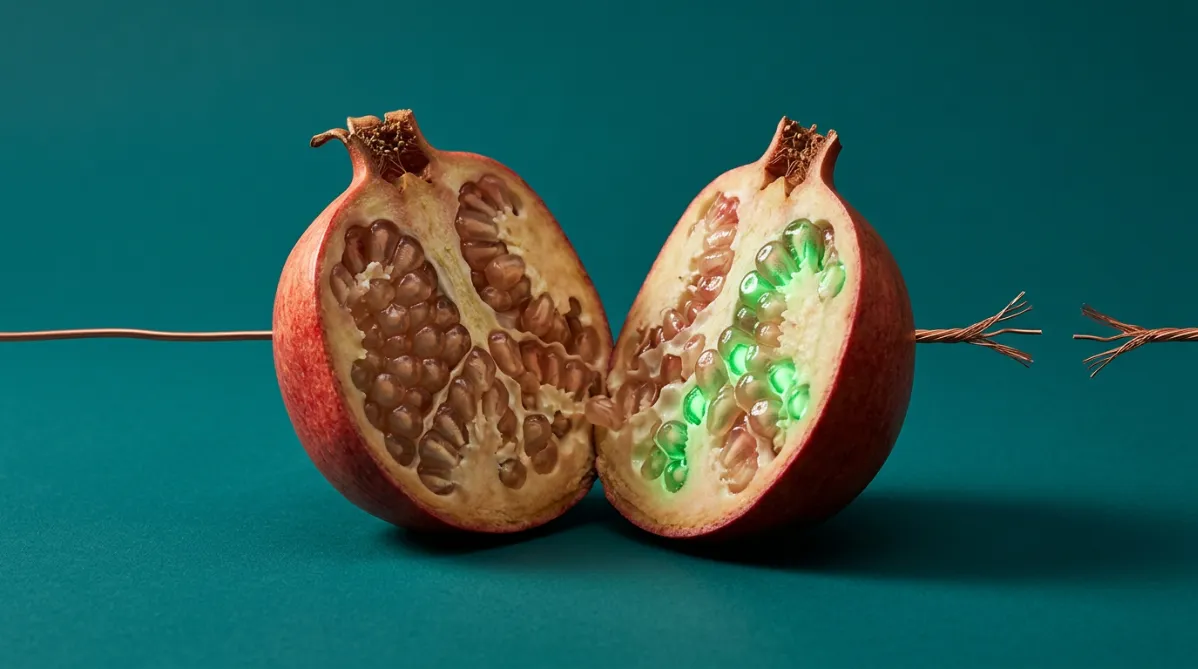
A single ripe pomegranate, split open, on a saturated teal backdrop. It is the natural source of urolithin A's precursors. The camera sits at a slightly low three-quarter angle, close enough to show glossy, translucent arils. On the left half, the arils sit dull and tightly packed. On the right, a few arils hold a faint electric green glow, as if lit from within, hinting at a selective response in one place and not another. Behind the fruit, a thin copper wire runs across the frame and is unbroken on one side and fraying on the other, standing for arteries versus brain vessels. Soft, directional studio light from the upper left casts crisp shadows. Mood: curious, restrained, quietly hopeful. No text anywhere.
supplements

Urolithin A Didn't Fix Arteries in 4 Weeks, but the Brain Responded

BY NOVA CHEN ·

A double-blind trial of 50 adults aged 40-64 with obesity found that 1,000 mg of urolithin A daily for four weeks did not improve flow-mediated dilation, the study's primary endpoint. Peripheral microvascular measures were also unchanged. Yet task-evoked cerebrovascular hemodynamic responses were significantly greater with urolithin A than with placebo, even though task performance did not budge. Because the brain result is a secondary outcome from a short, small trial, it is a lead rather than a conclusion. Here is what the data show, what they don't, and what it means for anyone considering the supplement.

This page is available in